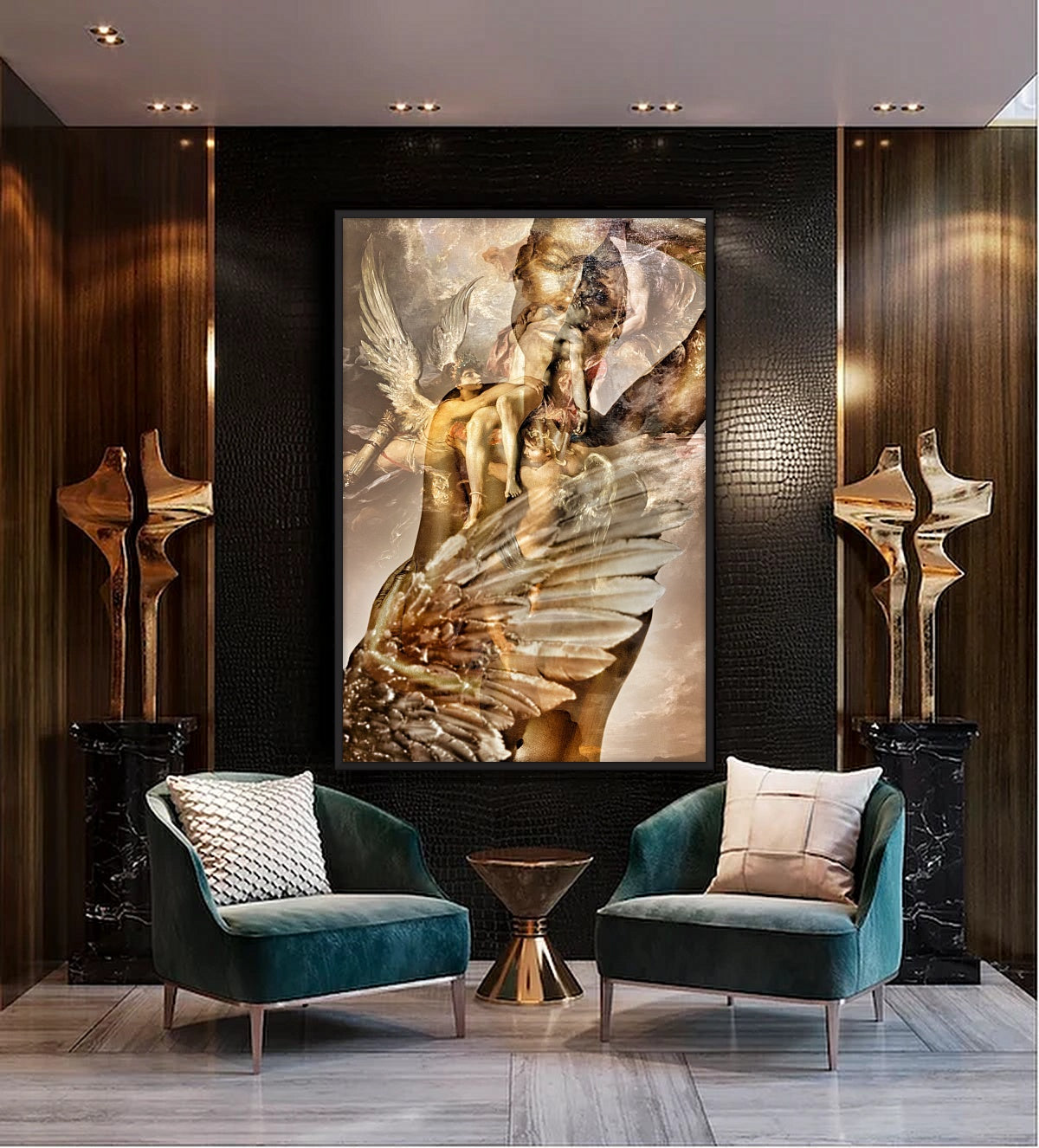
From the Arts District to Highland Park: The Italian Renaissance Reimagined in Gold for Dallas’s Finest Interiors
The Italian Renaissance changed forever how the world understands beauty, the human body, light, space and emotion. Centuries later, its visual language is still very much alive. It is not a historical style to copy, but a source of inspiration to reinterpret. Dallas has embraced that language with true Texas ambition. On Turtle Creek, The Mansion was built in the 1920s as a private residence in the Italian Renaissance style before becoming one of America's most celebrated hotels. And downtown, the Dallas Arts District has grown into the largest contiguous urban arts district in the United States, a place where museums, opera and architecture by Pritzker Prize winners stand side by side.
For the French-American artist and photographer of Italian descent Zack Zublena, the Renaissance becomes a contemporary visual dialogue. Through gold body paint, photography, collage and mixed techniques, he takes classical figures, golden light, mythology and sculptural forms out of their original context and gives them a place in the interiors of today.

Discover the Italian Renaissance collection: works that sit between classical beauty, mythology and golden light.
This approach does not try to recreate Renaissance painting. It asks a different question: what happens when the visual language of the Italian Renaissance is seen through the lens of contemporary fine art photography?
When Photography Meets the Renaissance
The Renaissance was an age of extraordinary experimentation. Artists explored anatomy, perspective, proportion, architecture, mythology and the relationship between the human figure and the space around it.
In the Dallas Arts District, that spirit of experimentation is everywhere. The Dallas Museum of Art, free to all, spans five thousand years of creativity, from ancient Mediterranean sculpture to European masters and contemporary art. Within it, the Wendy and Emery Reves Collection recreates the rooms of a Mediterranean villa filled with paintings, sculpture and decorative arts, a reminder that great art was always meant to be lived with.
Photography offers another way to explore the same ideas. In Zack Zublena's work, the camera is a tool for building images, not just recording reality. The human figure can look monumental, mysterious, almost architectural. Gold turns skin into something close to gilded sculpture. Shadows create the depth of a fresco.

Archangel Michael, Golden Guardian brings several of these ideas together: the monumental figure, the symbolism of wings and the power of gold. The work speaks to Renaissance iconography while remaining unmistakably contemporary.
Light as a Language
In Renaissance art, light was never just a technical element. It was a language. A face emerging from darkness could become the centre of an entire composition. A hand lit against a shadowed background suddenly became symbolic.
Dallas has some of the most beautiful light in Texas architecture. At the Nasher Sculpture Center, Renzo Piano designed glass vaults with a delicate sunscreen that lets the Texas sun fall softly over the sculpture galleries. In Thanks-Giving Square, the Glory Window spirals upward in a ribbon of stained glass by Gabriel Loire, its colours deepening into gold at the top. Gold also shines at Fair Park, where the gilded Tejas Warrior has guarded the entrance to the Hall of State since the Texas Centennial of 1936. Zack Zublena works with controlled light and deep contrast that give his images an almost painterly quality. The gold recalls gilded frames, Renaissance altarpieces and the golden light of a Texas sunset over the skyline. In photography, it takes on a new physical quality: reflective, atmospheric and contemporary.
Anatomy of the Soul explores the relationship between the human body and the atmosphere around it. The figure stops being the portrait of a specific person. It becomes a study of form, identity and the link between the physical and the symbolic.
The Human Body as Sculpture
One of the strongest connections between the Renaissance and contemporary fine art photography is how they treat the human body. Renaissance artists studied anatomy with extraordinary precision, inspired by the sculpture of antiquity.
Photography approaches the same subject from another direction. Through pose, light, framing and composition, a photographed figure becomes sculptural. Without unnecessary detail, the eye focuses on silhouette, muscle, gesture and empty space. In the Nasher's garden, among live oaks and water, Rodin, Giacometti and Henry Moore show how the human figure can become pure form: bronze bodies that hold the light like living sculpture.

Winged Essence takes this idea further. It joins the human figure with wings and a bold visual language of gold and blue, the colours of a big Texas sky at golden hour. The work recalls religious and mythological imagery without belonging to a single era.
Wings, Myth and the Renaissance Imagination
Wings have lived in the imagination of Western art for centuries. Angels, messengers and allegorical figures fill Renaissance painting and sculpture. Dallas has its own winged legend: Pegasus. Since 1934, the glowing red flying horse of classical mythology has crowned the Dallas skyline, first on top of the Magnolia Building. Restored, the original Pegasus now stands downtown, still the most beloved symbol of the city. It is a figure straight out of ancient myth, adopted as an emblem of Dallas.
Wings can also be read in a more abstract way: as an image of freedom, transformation, desire, transcendence, or the longing to go beyond the physical world.

Wings of Desire plays with this symbolic vocabulary. Film lovers will recognise the title of Wim Wenders' classic. Here the wings are far more than ornament. They make the figure ambiguous, suspended between earthly beauty and something almost celestial.
That ambiguity is at the heart of contemporary readings of the Renaissance. The goal is not to imitate the past, but to let its symbols take on new meanings.
A Beauty That Does Not Age
Renaissance images still move us because they see beauty as something bigger than fashion. Their faces, bodies and gestures speak of universal themes: desire, mortality, spirituality, identity, love and the search for meaning.

Symphony of Her Soul approaches the figure through emotion and atmosphere. With its Venetian mask and sheet music, the image creates a contemporary story in which music, movement and the body merge. It evokes a night with The Dallas Opera in the Winspear Opera House, Foster + Partners' glowing red drum, where Verdi and Puccini fill the hall. It equally evokes an evening with the Dallas Symphony Orchestra in I. M. Pei's Meyerson Symphony Center, celebrated for its extraordinary acoustics.
From the Italian Masters to Contemporary Interiors
The great masters of the Renaissance created for architecture: churches, palaces and private residences. Their compositions were designed to speak with the space that held them. Dallas's great homes carry that same ambition, from the Italianate and Mediterranean estates of Highland Park to the modern glass residences of Preston Hollow.
Contemporary fine art photography can play the same role. A large-format work becomes an architectural element. It can live in an estate in Highland Park or University Park, a modern residence in Preston Hollow, or a home along Turtle Creek or in Bluffview. It suits a penthouse in Uptown, a house by White Rock Lake in Lakewood, or a residence in Southlake, Westlake or Frisco. It also belongs in a restaurant in the Design District or the lobby of one of Dallas's grand hotels. A monumental figure sets the scale. A restrained palette creates atmosphere. Gold brings warmth and light without overloading the space with colour, in natural dialogue with limestone, marble, walnut, leather and the generous light of North Texas.

The Gladiator Philosopher shows this relationship between classical visual language and contemporary interior design. The work carries the monumental presence of classical and Renaissance figures while working as a statement piece for today.
The Renaissance as a Living Language
Perhaps the most interesting way to look at the Italian Renaissance today is not as a closed era, but as a visual language that keeps evolving. That language is made of the human body, dramatic light, mythology, architecture, symbols, gold and gesture. It is also made of the relationship between beauty and emotion.
These elements can be photographed, built digitally, turned into collage and reinterpreted. They can even be deliberately detached from their historical context. Dallas knows this well. At SMU, the Meadows Museum, often called "the Prado on the Prairie", holds one of the finest collections of Spanish art outside Spain, from the Spanish Golden Age of Velázquez and Murillo to Goya. Those painters learned from the Italian Renaissance and transformed it into an art all their own. The same spirit shaped Highland Park Village, built in 1931 in the Spanish Mediterranean style, where courtyards and towers inspired by Mediterranean Europe were reimagined for Texas.

Serpent of Light introduces another archetypal symbol: the serpent, which since antiquity has stood for transformation, renewal and knowledge. Set against a Pompeii fresco, the work brings together mythology, transformation and mystery. It builds a bridge between ancient imagery and contemporary fine art photography.
The Body, Light and the Classical Ideal
The Renaissance fascination with the human body was deeply tied to the classical world. In the Dallas–Fort Worth area, that ideal has an extraordinary home. Just down the road at the Kimbell Art Museum, Michelangelo's The Torment of Saint Anthony, his earliest known painting and the only one in the Americas, hangs beneath Louis Kahn's luminous vaults, where natural light reveals how the young master modelled the body.
Contemporary photography can revisit this ideal without turning it into an absolute rule. The body becomes material for composition: a line, a silhouette, a volume and a source of light.

Golden Tension explores this relationship through the male figure. The tension between body, light and shadow gives the image a sculptural strength and places it firmly in contemporary fine art photography.
A Meaningful Gift for the Holidays
Finding the right gift for someone who loves art, design, architecture and beautiful interiors is not easy. A work of art is different. It is not just a gift to unwrap, but a piece that becomes part of a home and keeps its meaning for years.
In Dallas, the holiday season is a season of warm gatherings: lights along the streets of Highland Park, dinners with family and friends, festive evenings at the Arts District and the countdown to the New Year. For those drawn to the beauty of the Italian Renaissance, to classical figures, mythology and golden light, a contemporary fine art photograph inspired by this tradition is a deeply personal choice for the holidays. For collectors in Highland Park, Preston Hollow, Uptown or Southlake, it is also a way to bring a piece of European art history into a contemporary Texas home.
If you are looking for a unique gift for someone who already has everything, an original work of art can be one of the most personal choices there is.
The Past, Seen Anew
The Italian Renaissance does not need to be recreated to stay relevant. Its ideas can be transformed. Its symbols can be questioned, simplified and reinvented. Its fascination with the human body can become contemporary photography. Its dramatic use of light can become a new atmosphere, and its mythology can be the starting point for entirely new stories.
Through gold, light, bodies, wings, mythology and emotion, Zack Zublena explores this vocabulary. He creates works that look to the past while belonging fully to the present.
Discover the Italian Renaissance collection: contemporary fine art photography inspired by classical beauty, mythology and the timeless visual language of the Renaissance.