Sacred Light: Holy Art Collection Prints for UK Sanctuaries
Beyond the Icon: A Contemporary View of Sacred Art
For centuries, sacred art has been shaped by specific figures, symbols and established narratives. Yet for many contemporary collectors and interior designers, the search for spiritual expression in art extends beyond traditional iconography. The aim may be to find artwork that resonates with a modern interior while creating an atmosphere suited to contemplation, meditation or quiet reflection.
This has opened a path for contemporary interpretations in which artists use elements such as light, colour, the human form and composition to explore questions of spirituality and the sacred. Within this context, holy art collection prints can provide a distinctive way to introduce contemplative imagery into a private home, wellness environment or personal sanctuary.
Fine art photography offers a particularly interesting approach because light is not simply represented within the image; it is one of the fundamental materials through which the photograph itself is created. Through carefully controlled highlights, shadows and tonal relationships, photography can transform the human figure into an image intended for slower, more reflective viewing.
The Victoria and Albert Museum’s photography collection demonstrates the breadth of photography as an artistic medium, spanning work from the nineteenth century to contemporary practice.
The Distinction Between Religious Décor and Sacred Fine Art
When selecting art for a personal sanctuary, there can be an important distinction between a decorative object and a work of fine art. Fine art photography emerges from an individual artist’s conceptual and visual approach, allowing a photograph to carry meaning beyond its role within the surrounding interior.
Works concerned with spiritual, metaphysical or symbolic themes can encourage personal interpretation rather than presenting a single fixed narrative. This capacity for individual response can make an artwork particularly suitable for spaces intended for reflection.
The relationship between art and private contemplation has a long history. The National Gallery in London describes how paintings were historically created not only for church ritual but also for the private devotion of religious communities and individuals, with images serving as a focus for meditation.
Contemporary sacred art can fulfil a different role within a modern interior, but the principle of using an image as a visual point of contemplation remains relevant.
Light as a Universal Language
In many contemporary works, literal religious imagery gives way to more symbolic representations of the sacred. Luminous effects, gold tones, darkness and carefully directed light can suggest ideas of transcendence, mystery, presence or transformation without requiring a specific theological interpretation.
Tate notes that abstract art has frequently been associated with ideas such as purity, simplicity and spirituality. This demonstrates how spiritual expression within modern art can move beyond direct representation and instead emerge through colour, form and visual relationships.
You can explore Tate’s introduction to abstract art for broader historical context on this relationship.
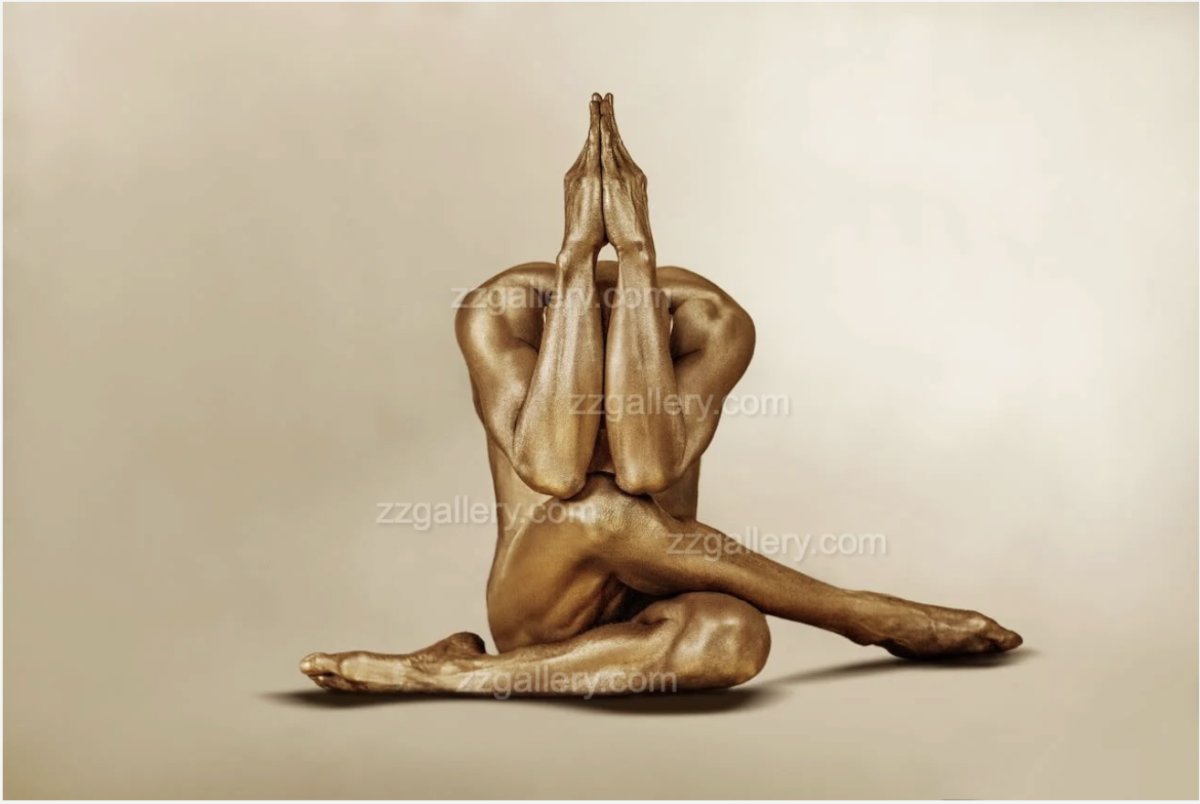
Within Zack Zublena’s photography, light is used to sculpt the gold-painted human form and establish a relationship between illumination and darkness. The resulting images invite viewers to develop their own interpretation of the figure, rather than prescribing a single spiritual meaning.
Choosing Sacred Prints for Luxury and Wellness Interiors
Selecting artwork for a space dedicated to contemplation or wellbeing requires consideration of more than the image alone. For interior designers and collectors curating private sanctuaries, meditation rooms, wellness centres or refined residential spaces, scale, architecture, lighting and viewing distance all contribute to the final experience of the work.
A large-format photographic print can establish a strong focal point on a substantial wall, while a smaller and more restrained composition may create a more intimate relationship with the viewer.
In a meditation room or private study, surrounding negative space can be particularly valuable, allowing the artwork to retain visual presence without competing with other decorative elements. In a larger living area, reception space or wellness environment, a more substantial composition can become an architectural anchor.
Materiality and Craftsmanship in Fine Art Prints
The physical characteristics of a photographic print contribute to the way the final work is experienced. Scale, surface, framing and presentation all influence how colour, contrast and detail are perceived within an interior.
Specifications may vary between individual artworks, so collectors should always consult the relevant ZZGALLERY product page for confirmed information regarding available dimensions, materials, formats and other artwork-specific details.
This is particularly important when planning an interior project in advance, as the dimensions and presentation of the artwork should be considered alongside furniture, architectural proportions and lighting.
Curating for Sacred Spaces and Wellness Centres
Art can play an important role in establishing the visual identity of wellness and contemplative environments. In spaces such as spas, yoga studios, private treatment rooms and premium wellness centres, a coherent selection of artwork can contribute to an atmosphere that feels considered rather than purely decorative.
Zack Zublena’s fine art photography has been installed in more than 120 David Lloyd Clubs across the United Kingdom and continental Europe. This extensive installation demonstrates how a consistent photographic language can be integrated across numerous fitness and wellness interiors.
For a large reception or communal area, a single statement photograph may establish the visual identity of the space. Smaller or more contemplative compositions can then be introduced into treatment rooms, corridors or quieter areas to create continuity without repetition.
The Golden Souls Collection, for example, explores the gold-painted human form through sculptural light and shadow. Its visual language can work particularly well within interiors where warmth, luminosity and contemplation are central to the design.
The Holy Collection: A Photographic Exploration of Light and Form
The Holy Collection by French artist Zack Zublena explores sacred themes through contemporary fine art photography.
The series combines the human form, gold-coloured body paint, darkness and carefully controlled illumination to create images with a sculptural and contemplative presence.
Rather than reproducing traditional religious iconography directly, the photographs use light, gesture and symbolism to encourage individual interpretation. For some viewers, the imagery may suggest ideas of reverence, transcendence or inner transformation; for others, the attraction may lie principally in the formal relationship between the body, gold and light.
This openness is important to Zack Zublena’s approach. The photograph provides a visual framework, but the viewer ultimately brings personal experience and meaning to the work.
Visualising the Sacred Through Photography
Zack Zublena’s photographic process transforms the human body through gold-coloured body paint and controlled studio lighting. The reflective surface catches highlights and shadows, giving the photographed figure a luminous and sculptural appearance.
The resulting image occupies a space between portraiture and symbolic representation. Individual identity can become secondary to gesture, form, light and presence, allowing the human figure to function as a broader visual metaphor.
The history of devotional art provides an interesting point of comparison. The National Gallery explains that small painted panels were historically created for personal devotion, while larger works were intended for altars or public religious environments.
A contemporary fine art photograph serves a very different artistic and cultural context, but scale and placement can still influence whether an artwork is experienced privately and intimately or as a more commanding visual statement.
Displaying Sacred Fine Art Photography
Lighting should be considered carefully when displaying photographic art. Illumination can reveal subtle tonal relationships within an image, but excessive or prolonged light exposure can also affect photographic materials over time.
The UK’s Institute of Conservation recommends avoiding high light levels and extended exposure when displaying photographs. UV-filtering glazing can also provide additional protection when appropriate.
For a contemplative interior, controlled lighting has an additional aesthetic benefit. Rather than illuminating the entire wall uniformly, carefully positioned ambient or architectural lighting can allow the photograph to emerge naturally within the room while preserving the contrast between luminous highlights and darker areas of the composition.
Building Your Personal Sacred Gallery
A personal collection can begin with a single work that holds particular meaning. Rather than attempting to fill an entire space immediately, begin with the photograph that produces the strongest response and allow the collection to develop around it.
Additional works can then be selected through shared relationships of colour, scale, gesture, light or symbolism. This approach can create a cohesive collection while still allowing individual photographs to retain their own presence.
Through the ZZGALLERY fine art photography collections, collectors can explore different bodies of work and consult individual artwork pages for confirmed specifications and availability.
For those interested in displaying several related works together, the fine art diptychs, triptychs and coordinated art sets provide another way to create a unified photographic installation.
A Personal Artistic Alternative
For those interested in becoming the subject of an artwork rather than selecting an existing print, Zack Zublena also offers the Gold Body Painting and Fine Art Photography Experience.
This separate bespoke experience involves painting the participant’s body gold before Zack creates a series of personal fine art photographic portraits. The resulting photographs are developed through a direct creative collaboration between artist and participant.
Whether selected for a private home, meditation space, personal sanctuary or wellness interior, sacred fine art remains a highly individual choice. The most meaningful work is ultimately the one whose imagery, composition and symbolism continue to resonate with the viewer over time.
Explore the Holy Collection, or contact ZZGALLERY for assistance selecting artwork for a private or professional interior.