How to Decorate a Large Wall with Fine Art: The Ultimate Luxury Interior Design Guide in Lisbon, Porto, and Cascais

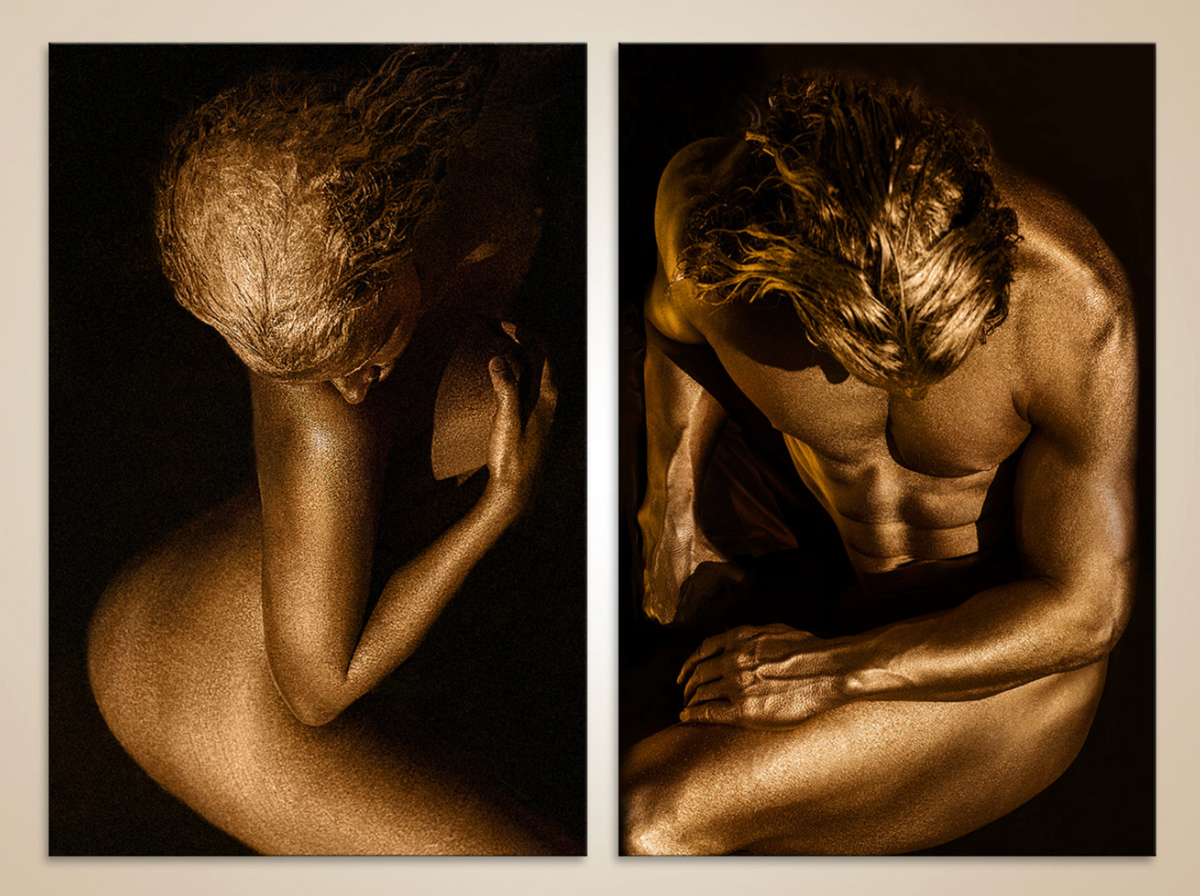
The "Golden Divine Couple" diptych by Zack Zublena. Two independent compositions united by golden tones, contemplative postures, and deep, dark backgrounds. Discover the artwork.
The stately historic apartments of Chiado and Baixa in Lisbon, contemporary coastal villas overlooking the Atlantic in Cascais, and the magnificent riverfront townhouses in Porto offer exceptional aesthetic opportunities and unique architectural challenges for high-end interior styling in Portugal. Yet, the timeless charm of traditional pombaline tiles, soaring ceiling heights, and whitewashed plaster walls never quite guarantees the seamless integration of fine art. No matter how powerful a photograph may be, ignoring its architectural and cultural context diminishes its impact, whereas a carefully curated and positioned piece infuses timeless elegance into the entire space.
Choosing fine art for a large wall begins with attentive visual observation and extends to a profound analysis of local architecture, bespoke woodwork, furniture proportions, and natural lighting axes. For interior architects, designers, and discerning collectors in Portugal, integrating Zack Zublena's fine art photography relies on precise visual balance: whether through a striking vertical portrait or a multi-panel diptych and triptych that paces a living space.
The ultimate goal is to select a piece that immediately captures the eye upon entering the room while retaining its hypnotic power of fascination over decades.
Understanding the Artwork and Spatial Scale
Before picking up a measuring tape, take a moment to contemplate the photograph deeply. Where does your eye instantly land? How does the human body inhabit the frame? What role does the surrounding negative space play? Does the photograph evoke contemplative quietude, majestic immensity, intimate vulnerability, or grounded strength?
Zack Zublena's golden figurative photography combines real human models, sculpted postures, and rigorously controlled studio lighting. The curve of a spine, a suspended gesture, or a luminous golden silhouette gives each artwork a powerful architectural presence. Enlarging the work amplifies this physical presence, but the acquisition choice must always remain anchored in the intrinsic strength of the composition.
Exploring the collections of prestigious institutions such as the Calouste Gulbenkian Museum in Lisbon, the Serralves Museum of Contemporary Art in Porto, and the National Museum of Ancient Art is essential for refining one's artistic eye and understanding the interaction between the body, light, and space within the Portuguese cultural landscape. Additionally, leading national publications such as Público and Expresso offer valuable insights into contemporary art and interior design trends.
When evaluating potential artworks, ask yourself a decisive question: which piece do your thoughts constantly return to? This synergy between initial impact and lasting visual fascination forms the bedrock of any enduring residential collection.
Vertical Formats on Wide Horizontal Walls
A wide wall does not automatically demand a horizontal or panoramic format. Large-format vertical artworks function exceptionally well as dominant focal points, particularly when their central axis aligns precisely with a low-profile coffee table, a precious wooden sideboard, or an assertive architectural volume.
Placing a large vertical panel above an elegant console or within a subtly lit architectural niche structures the room and draws the gaze upward. True interior harmony never stems from randomly filling square meters, but from the precision of proportions.
The surrounding negative space—or visual "breathing zone"—acts as an active component of the overall composition. This perimeter cushion allows the artwork to detach from surrounding furniture and achieve total visual independence. Before choosing the maximum possible size, ensure the scale enhances the artistic narrative rather than merely filling a void.
When the Diptych or Triptych Becomes the Ideal Solution
A diptych consists of two panels, while a triptych features three. These modular formats cover vast surfaces without creating visual monotony, introducing rhythmic pauses between each section.
While some series unfold a continuous panoramic landscape across multiple modules, others connect independent shots through a unified conceptual thread. In both cases, the dialogue between the panels must be rigorous and distinct.
The "Golden Divine Couple" diptych, presented at the beginning of this article, bridges two autonomous compositions. The golden hues, dark backdrops, and converging movements create an ongoing exchange while granting each panel its own geometric rigor. The gaze travels fluidly between the two figures before lingering on the intricate details of each shot.
Multi-panel artworks are particularly suited for double-height ceilings, grand entrance galleries, or spacious reception salons. The final configuration depends entirely on the atmosphere you wish to evoke.
Before finalizing exact dimensions, create full-scale paper mockups and tape them to the wall, taking care to account for the spacing between panels. These interlignes dictate the fluid transition from one frame to the next. Explore these configurations further through Zack's guide on diptychs, triptychs, and multi-panel photography.
Precise Dimensional Calculations: Framing, Matting, and Environment
Catalog dimensions typically refer only to the print or paper size, omitting the final footprint of the framed artwork. The window mat, moulding thickness, and mounting depth significantly increase the piece's overall footprint on the wall.
Measure your available space with absolute rigor, accounting for light switches, ventilation grilles, and historical architectural elements. Using full-scale paper templates prevents any misjudgment during final installation.
Observe the defined perimeter from multiple angles in the room: the main entrance, lounging areas, and natural pathways. This practical test instantly validates the balance of the composition or indicates whether the piece should be shifted by a few centimeters.
For diptychs and triptychs, materializing interstitial spaces requires millimeter precision. What appears flawless on a computer screen may require adjustments when confronted with architectural reality.
Adapting to Viewing Distances
A large-format photograph installed in a sweeping Lisbon penthouse or a contemporary coastal villa must be read clearly from a distance, drawing attention through assertive silhouettes and balanced tonal contrasts.
Upon closer approach, however, a delicate and richly detailed universe unfolds: the physical texture of 24-karat gold leaf, subtle skin tone nuances, and the precise anatomical posture of each subject. This multidimensional visual test ensures the artwork remains captivating and relevant over decades.
When planning your decor, consider the daily uses of the space. In a grand reception salon, long-term visual impact takes precedence; above a sofa or in a more intimate alcove, tactile close-up details take over.
To broaden your perspective on how art integrates with contemporary architecture and design, consult specialized publications and architectural platforms such as ArchDaily alongside premier interior design magazines.
The Dialogue Between Gold and Exceptional Portuguese Architecture
The radiant golden tones of Zack Zublena's works weave a warm dialogue with the noble materials characteristic of high-end architecture and decoration in Portugal: traditional hydraulic tiles, rich dark wood accents, natural stone, and polished metals.
Against deep, dark backgrounds—such as an anthracite grey, an empire green, or an intense midnight blue—the human form enhanced with gold acquires a timeless, statuary, and sovereign presence.
There is no need to duplicate gold in every decorative accessory in the room; authentic elegance arises from a controlled contrast between warm and cold textures, and the tension between organic body curves and architectural rigor.
Avoid acquiring art dictated by fleeting seasonal color palettes. Major artworks endure through time, valued by their conceptual depth, compositional rigor, and lasting emotional resonance.
Museum-Grade Lighting: Protection and Enhancement
Observe the path of natural light across your wall throughout the day. Direct rays through large windows can cause unwanted reflections and long-term material alteration, whereas thoughtful nocturnal artificial lighting precisely highlights shadows and volumetric lines.
The use of track lighting equipped with high Color Rendering Index (CRI) LED spots is recommended, avoiding light sources that emit excessive heat. Museum conservation standards for photography advocate for special anti-UV glass to guarantee the longevity of the artwork.
The objective is not to flood the wall with direct light, but to shape a precise focal point that preserves dramatic contrasts and rich detail within shadowy zones.
The Frame as the Formal Boundary of the Artwork
The frame acts as the ultimate threshold between the photographic universe and the surrounding architecture. A sober, deep shadowbox (caisse américaine) focuses all attention on the image itself, while a heavier moulding provides strong structural grounding.
Consider the depth of the frame profile relative to the overall paper dimensions. For multi-panel series, adopting rigorously identical framing specifications is a non-negotiable condition for preserving visual coherence.
Consult art framing studios to ensure the use of neutral, acid-free materials. For heavy large-format pieces, a secure and invisible wall mounting system is an absolute technical necessity.
Art That Accompanies and Transforms Daily Life
A carefully chosen artwork for a statement wall evolves with the household. Over time, changing light dancing across the gold leaf will reveal new shadows, gestures will acquire deeper layers of meaning, and the piece will naturally establish itself as the aesthetic heart of the space.
Whether it is a striking vertical portrait or a harmonious multi-panel composition, the true value of your choice lies in the emotional connection it radiates. Architecture sets material boundaries, but art infuses space with its soul and presence.
We invite you to discover Zack Zublena's Golden Souls collection as well as his fine art diptychs and triptychs. For any questions regarding available formats, exclusive editions, or bespoke interior design projects, please feel free to contact Zack Zublena directly.

Written by Zack Zublena