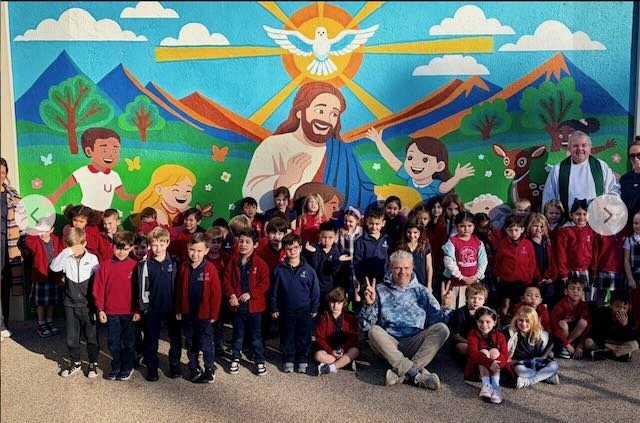
The photograph above shows French artist Zack Zublena seated in front of the large mural he painted for Saint Mel Catholic School in Woodland Hills, surrounded by children from the school’s kindergarten class and the parish priest after the work was completed.
At the center of the mural, Jesus welcomes the children with open arms. Above him, a white dove representing the Holy Spirit appears within a radiant sun. Mountains, trees, flowers, clouds, animals, and smiling children complete the landscape, transforming the school wall into a colorful expression of faith, joy, inclusion, and community.
The photograph documents more than the completion of a commissioned mural. It captures the moment when an artwork created directly on a school wall became part of the children’s everyday environment.
Although Zack Zublena is now widely known for his fine art photography, gold body painting, and contemporary portraiture, this mural reveals another dimension of his artistic practice: the ability to tell a story on an architectural scale using paint, symbolism, color, and human expression.
A Catholic Mural Created for Children
Creating religious artwork for a Catholic school requires a different visual approach from creating a work for a church, gallery, private collection, or luxury interior.
The imagery must remain spiritually meaningful while also feeling welcoming and understandable to children. In this mural, Jesus is not presented as a distant or severe figure. He is placed among the children, looking toward them with an open expression and extending his arms across the composition.
The children painted around him reflect the diversity and energy of a real school community. Their smiles and gestures introduce movement, while the surrounding animals, flowers, trees, and mountains create a world that feels safe, abundant, and alive.
The dove and radiant light establish the sacred dimension of the scene without making the composition intimidating. Christian symbolism is integrated into a landscape that children can immediately recognize and enjoy.
This balance between religious meaning and accessibility was central to the commission. The objective was not simply to decorate an empty wall. It was to create an image capable of communicating welcome, compassion, faith, and belonging every day.

Zack Zublena originally painted this portrait to support and encourage Father Steve during his cancer treatment. The deeply personal gift later led Saint Mel Catholic School in Woodland Hills to commission Zublena’s monumental mural depicting Jesus playing with children.
Why Art Matters in a School Environment
Art can influence how students perceive and remember the spaces in which they learn.
A commissioned mural gives a school a visual identity that cannot be reproduced by generic decoration. Because the artwork is created specifically for the institution, it can reflect the school’s values, community, history, and spiritual mission.
The United States Department of Education recognizes visual arts as part of a well-rounded education and supports projects that strengthen connections among schools, students, communities, and arts organizations through its Arts in Education National Program.
The National Endowment for the Arts’ arts education resources similarly emphasize the place of artistic experiences in the education and development of young people.
A mural does not replace formal arts education, but it makes artistic expression visible within the students’ daily environment. It demonstrates that art can occupy an important and permanent place in a community.
For children who pass the mural each day, the wall is no longer simply part of the building. It becomes an image associated with their school years, their classmates, and their shared experience.
Creating Belonging Through a Shared Image
The completed photograph is especially meaningful because the students are gathered directly in front of the mural.
The real children and the painted children become part of the same visual scene. The image on the wall reflects the community standing before it, while the open arms of Jesus provide a unifying center.
This relationship connects the mural to the idea of school belonging.
The Centers for Disease Control and Prevention defines school connectedness as the experience of students feeling that adults and peers at school care about them, value them, support them, and care about their learning.
A mural alone cannot create that connection. However, a work conceived for a particular school can reinforce the messages and values that the institution wants children to encounter: that they are welcomed, represented, protected, and part of a larger community.
In this composition, the children are not passive figures placed at the edge of a religious scene. They are central to it. Their presence gives meaning to the gesture of Jesus and turns the mural into an image of encounter rather than observation.
Painting the Catholic School Mural
The creation of a large mural is both an artistic and physical process.
Unlike a work developed on a small canvas, a wall painting must be evaluated from several distances. The artist works close to the surface while continually stepping back to judge proportion, rhythm, color, visibility, and the relationship between the artwork and its architecture.
The first stage involves organizing the overall composition. The principal figures must be positioned so that they remain legible across the full wall. Secondary elements such as mountains, trees, clouds, animals, and flowers then create movement and connect the central scene to the surrounding space.
Color plays an especially important role in an educational environment. The turquoise sky establishes an immediate sense of openness. Green fields and trees connect the scene to nature, while orange, yellow, blue, and red accents give the mural warmth and energy.
The scale of Jesus provides a clear focal point, but the surrounding children and landscape keep the composition active and approachable.
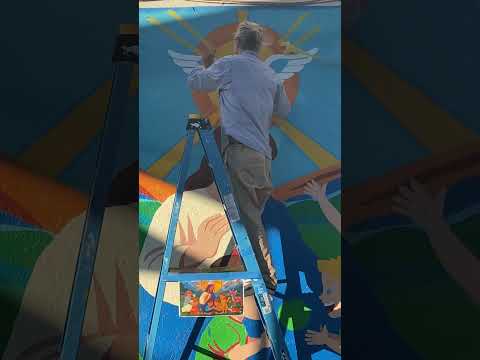
Watch Zack Zublena Paint the Holy Spirit
This video captures Zack Zublena working directly on the school wall as he paints the white dove representing the Holy Spirit. Positioned within the radiant sun above Jesus, the dove is one of the mural’s central Christian symbols. The footage offers a close view of the artist’s brushwork and the careful development of this important element as the composition gradually comes to life.
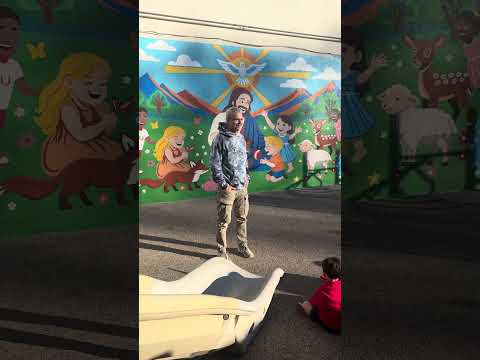
The Story Behind the St. Mel School Mural
In this video, the parish priest introduces Zack Zublena to the kindergarten students gathered in the school courtyard. He explains that after Zack created a portrait for the priest, the school invited the artist to paint the monumental mural that now stands behind them. The gathering captures the moment when the completed artwork was presented not simply as a painting, but as a work created for the children and their school community.
These videos are important documents because they demonstrate that the finished image was created through a sustained, hands-on painting process. Viewers can see the scale of the undertaking and the sequence of decisions required to transform a blank architectural surface into a complete narrative.
Sacred Art Within a Catholic Environment
Catholic sacred art has historically used recognizable figures, gestures, light, and symbols to communicate religious meaning.
The United States Conference of Catholic Bishops discusses the relationship between faith, artistic expression, architecture, and community in its guidance on environment and art in Catholic worship.
A school is not identical to a liturgical space, and this mural was created for an educational environment rather than as a substitute for church art. Nevertheless, the same broader principle remains relevant: visual art can help make spiritual ideas present within a physical place.
In Zack Zublena’s mural, the Christian message is communicated through relationships.
Jesus reaches toward the children. The dove appears above the central figure. Light spreads outward across the sky. Nature surrounds the group, and the entire scene is organized around welcome rather than separation.
The mural’s religious identity is therefore clear, but its emotional language remains accessible to young viewers.
From Mural Painting to Fine Art Photography
This Catholic school commission also provides insight into Zack Zublena’s later work as a fine art photographer.
A muralist learns to think about scale, focal points, visual rhythm, architectural placement, and the way an image affects a room. Those same considerations remain important when creating and installing large-format fine art photography.
Zublena’s photographic work uses a different medium and a more contemporary visual vocabulary, but several underlying concerns remain consistent: the human figure, spiritual symbolism, transformation, light, color, and the relationship between an artwork and the person viewing it.
His current practice frequently transforms photographed bodies and faces through gold, shadow, texture, and saturated color. The resulting compositions are more abstract and sculptural than this school mural, yet both forms of work explore the possibility of making an interior feel emotionally and visually distinct.
Viewers can explore Zack Zublena’s current fine art photography collections.
Understanding the Permanence of a Mural
A mural is inseparable from the wall on which it is painted. That permanence gives the work a special relationship with the building and the people who use it.
It also makes material preparation and long-term care important. Walls can be affected by moisture, sunlight, surface movement, impact, and changes to the building. Paint selection, surface preparation, and environmental conditions can all influence how the work ages.
The United States National Park Service has documented the specialized assessment and conservation required to stabilize and preserve historic murals. Although a contemporary school mural and a historic protected mural have different conservation requirements, the example demonstrates why large wall paintings should be understood as physical artworks rather than temporary graphics.
Photographs and videos of the painting process also become valuable parts of the project’s record. They preserve evidence of the artist’s methods, the mural’s original appearance, and the community present when it was completed.
The strongest aspect of this commission is its specificity.
It was not designed as an interchangeable image for an anonymous wall. It was painted for a Catholic school and conceived for the children who would encounter it there.
The final photograph makes that purpose visible. Zack Zublena is not photographed alone in front of the mural as if it existed only as an example of his portfolio. He is seated among the students, with the school community occupying the foreground and the painted community extending across the wall behind them.
Together, the mural and photograph preserve a moment of collective ownership. The artist created the work, but once completed, it became part of the school’s environment and memory.
Beyond Photography: The Expanded Practice of Zack Zublena
“Beyond photography” does not mean abandoning photography. It describes an artistic practice that is not limited to a single medium.
Zack Zublena’s work has included drawing, painting, murals, body painting, portraiture, digital composition, and fine art photographic production. Each medium offers a different way to explore the body, identity, spirituality, transformation, and visual presence.
The Catholic school mural demonstrates his ability to adapt his artistic language to a young audience and a faith-based environment. His contemporary photography takes these interests in another direction, using gold, darkness, light, and abstraction to create works for collectors and professional interiors.
His experience with permanent, site-specific painting also helps explain the attention he gives to the physical presence of artwork within architecture.
ZZGALLERY’s fine art photography has been installed as part of the interior decoration of more than 120 David Lloyd Clubs across the United Kingdom.
These projects differ substantially from the Catholic school mural, but they share an important principle: artwork should be created or selected with an understanding of the people who will encounter it and the environment it will inhabit.
Commissioning Artwork by Zack Zublena
Zack Zublena’s principal practice is gold-centered fine art photography for collectors and professional interiors. He also considers selected mural and site-specific commissions for schools, organizations, and other meaningful environments.
Depending on the project, a commission may involve an original photographic composition, a custom portrait, artwork selection for an interior, or another artist-led visual concept.
Every project begins with its intended location, audience, scale, and purpose. This allows the finished artwork to respond to the environment rather than functioning as generic decoration.
To discuss a commission or professional art project, contact ZZGALLERY.
Frequently Asked Questions
Who painted the Catholic school mural shown in the photograph?
The mural was painted by French artist and fine art photographer Zack Zublena. The photograph shows him seated in front of the completed wall painting with children from the school’s kindergarten class and a member of the clergy.
What does the mural represent?
The mural depicts Jesus welcoming children within a colorful natural landscape. A white dove representing the Holy Spirit appears above him, surrounded by radiant light. Mountains, trees, flowers, clouds, and animals complete the scene.
Why was the mural designed with such bright colors?
The mural was created for an environment used by children. Its bright palette makes the religious imagery welcoming, legible, energetic, and accessible to young viewers while giving the school wall a strong visual identity.
How was the mural painted?
The artwork was painted directly on the wall through a multi-stage process involving compositional planning, drawing, large areas of color, development of the figures and landscape, details, highlights, and final corrections. The accompanying YouTube videos document parts of this process.
How does mural painting relate to Zack Zublena’s photography?
Mural painting requires an understanding of scale, composition, focal points, color, architectural placement, and viewing distance. These considerations also influence the way Zack Zublena creates and presents large-format fine art photography.
Does Zack Zublena still create commissioned artwork?
Zack Zublena accepts selected commissions and works with private and professional clients. The format and feasibility of each project depend on its location, dimensions, intended audience, schedule, and artistic requirements.